
Choosing the right accounting software in the UAE is no longer a back-office decision. With over 350,000 businesses now registered for VAT, a 9% Corporate Tax in full effect since June 2023, and the FTA's phased e-invoicing mandate beginning in 2026, the wrong system can cost a UAE business AED 10,000 or more in first-instance penalties alone. According to the UAE Federal Tax Authority, the country's tax environment has shifted from "register and file" to continuous, structured digital reporting — and your accounting software is the system that has to keep up.
This guide ranks the 10 best accounting software for UAE businesses in 2026 based on FTA compliance, e-invoicing readiness, pricing in AED, and fit for Free Zone, mainland, and international companies. Each tool is evaluated against the same five-factor methodology so you can make an informed decision.
Quick Summary / TL;DR
Short on time? Here is what you need to know.
| If You Want To… | Use This | Expected Impact | Setup Time |
|---|---|---|---|
| Run a Free Zone or website-integrated business | Site.pro | One platform for site, sales, VAT | 1–2 days |
| Get FTA-accredited cloud accounting for SMEs | Zoho Books UAE Edition | Direct EmaraTax VAT filing | 2–4 days |
| Use the global standard your accountant knows | QuickBooks Online | Strong reporting + UAE VAT add-on | 3–5 days |
| Add unlimited users on cloud accounting | Xero | Real-time books, 1,000+ apps | 3–5 days |
| Handle heavy inventory and trading | Tally Prime | Batch tracking, multi-warehouse | 1–2 weeks |
| File VAT in Arabic and English natively | Wafeq | FTA-aligned, bilingual invoices | 1–2 days |
| Get AI-driven VAT and CT automation | CrossVal | AI files returns on EmaraTax | 1 day |
| Invoice as a freelancer or solo consultant | FreshBooks | Time-tracking + simple invoices | Same day |
Expert Recommendation
According to the UAE Ministry of Finance, only structured XML invoices routed through an Accredited Service Provider (ASP) will be valid e-invoices once the mandate goes live. Any 2026 software choice should already have a clear PEPPOL PINT-AE roadmap.
Why UAE Businesses Need Modern Accounting Software in 2026

The UAE tax environment changed permanently between 2018 and 2026. VAT at 5% arrived first, followed by a federal 9% Corporate Tax in June 2023, and now the FTA's e-invoicing rollout — built on the Peppol PINT-AE standard — will be mandatory for large businesses by 1 January 2027, with a pilot starting July 2026, per official Ministry of Finance guidance.
The compliance burden has three layers every UAE business now has to handle inside its books:
- VAT 201 filing — Every quarter (or monthly for larger taxpayers) through EmaraTax.
- Corporate Tax registration and annual return — Required for every taxable person, including most Free Zone entities.
- Structured XML e-invoicing — Via an Accredited Service Provider (ASP) once the phased mandate begins.
Manual spreadsheets cannot keep up. Late filing alone triggers a minimum AED 1,000 penalty and AED 2,000 for repeat violations, based on Cabinet Decision No. 49 of 2021, with additional percentage-based penalties on unpaid tax. The right software prevents most of these errors at the data-entry stage.
How We Ranked the Best Accounting Software for UAE
Each tool was scored against a five-factor methodology drawn from FTA documentation, UAE accounting service providers, and verified vendor pricing as of Q2 2026:
| Criteria | Weight | What We Measured |
|---|---|---|
| FTA & VAT Compliance | 30% | VAT 201 automation, FTA Audit File, EmaraTax integration |
| E-Invoicing Readiness | 20% | PINT-AE / PEPPOL roadmap, ASP partnerships |
| Local Fit | 15% | Arabic support, AED currency, UAE bank feeds |
| Pricing & Scalability | 15% | AED transparency, user limits, plan upgrades |
| Automation & Integrations | 20% | AI features, e-commerce sync, bank reconciliation |
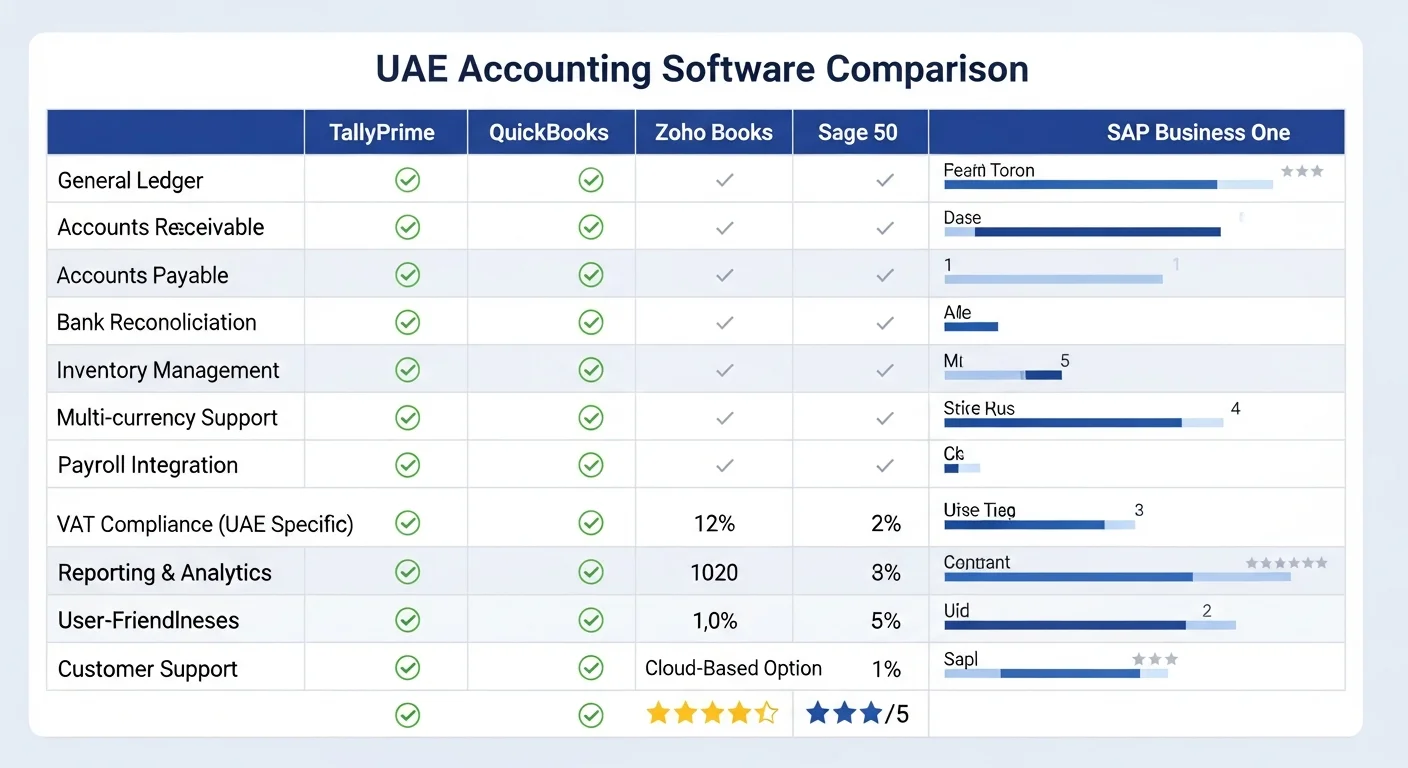
Master Comparison: 10 Best Accounting Software for UAE in 2026
| Rank | Software | Rating | Difficulty | Starting Price (AED/mo) | Best For |
|---|---|---|---|---|---|
| 1 | Site.pro ↗ | ★★★★★ | Easy | Custom (Free Zone plans) | Free Zone & website-integrated businesses |
| 2 | Zoho Books | ★★★★★ | Easy | ~AED 55 | UAE SMEs needing FTA-accredited accounting |
| 3 | QuickBooks Online | ★★★★ | Easy | ~AED 90 | International SMEs |
| 4 | Xero | ★★★★ | Medium | ~AED 70 | Cloud-first teams with unlimited users |
| 5 | Tally Prime | ★★★★ | Medium | AED 2,340 (one-time) | Trading and inventory-heavy businesses |
| 6 | Wafeq | ★★★★ | Easy | AED 53 | Arabic-first and GCC-native businesses |
| 7 | Sage Business Cloud | ★★★ | Easy | ~AED 220 | Growing service businesses |
| 8 | Odoo | ★★★★ | Hard | Free–Custom | Businesses wanting ERP + accounting |
| 9 | CrossVal | ★★★★ | Easy | Custom | AI-driven VAT and CT automation |
| 10 | FreshBooks | ★★★ | Easy | ~AED 60 | Freelancers and solo businesses |
All AED prices are indicative as of Q2 2026 and may vary by vendor promotion, user count, and exchange rate. Always check the vendor's UAE-specific pricing page before purchase.
1. Site.pro — Best for Free Zone Companies & Website-Integrated Businesses
Why Site.pro Ranks #1
Site.pro is the only platform in this ranking that natively combines UAE-compliant accounting, e-invoicing, website management, and e-commerce sync in a single cloud system — without requiring three separate tools and a middleware layer. For the UAE's 40,000+ Free Zone businesses, that integration is genuinely unique in 2026.
Site.pro is a cloud-based accounting and ERP platform built specifically for UAE businesses, including SMEs and Free Zone companies. What sets it apart is its native combination of accounting, invoicing, VAT compliance, and website / e-commerce integration in a single platform — instead of stitching together three or four separate tools.
For Free Zone companies that already run their commercial activity through a website or an online store, that integration is the difference between recording every sale twice and recording it once. Sales from Amazon, Shopify, and connected payment systems flow directly into the books, where Site.pro applies VAT treatment and prepares the data for VAT return reporting.
Key Features
- VAT 201 automation with data prepared for EmaraTax submission
- UAE Corporate Tax module including qualifying income and Free Zone position tracking
- E-invoicing capability with PEPPOL PINT-AE roadmap for 2026–2027 mandate
- Built-in website builder and e-commerce platform connected to the accounting module
- Multi-currency and AED as default currency
- Bilingual Arabic and English interface and invoicing
- Shopify, Amazon, WooCommerce, and payment gateway sync
- UAE bank reconciliation for major local banks
- AI-assisted invoice recognition and expense categorisation
- Free Zone entity templates including DMCC, DIFC, JAFZA, and DSO configurations
Pros
- Only UAE platform that combines website, e-commerce, and accounting in one system
- Genuine Free Zone-specific configuration out of the box
- E-invoicing PINT-AE roadmap already confirmed
- VAT 201 and Corporate Tax in the same platform
- Reduces 3–4 tool stack to one monthly fee
- AI-powered automation across invoicing and reconciliation
Cons
- Custom pricing requires a consultation call to confirm
- Less globally recognised than QuickBooks or Xero
- Smaller third-party app ecosystem than Zoho Books
- Deepest value for website-running businesses; pure-accounting-only firms get less ROI
Best for: UAE Free Zone companies, e-commerce sellers, and SMEs that want their website, online sales, and accounting connected in one cloud system — not three.
2. Zoho Books — Best for UAE SMEs Seeking FTA-Accredited Cloud Accounting
Zoho Books UAE Edition is one of the few cloud accounting platforms officially accredited by the UAE Federal Tax Authority. It handles VAT, Corporate Tax, and FTA Audit File generation natively — not through third-party add-ons. For SMEs that want full FTA compliance baked into the software, Zoho Books is the most-cited option in UAE accounting circles in 2026.
Key Features
- Direct EmaraTax VAT 201 filing and FTA Audit File (FAF) generation
- UAE Corporate Tax module with CT-ready reporting
- UAE bank feeds for HSBC, Emirates NBD, Mashreq, RAK Bank, and others
- Bilingual (Arabic / English) invoicing with TRN, QR code, and tax breakdown
- Multi-currency with auto-FX rates
- Self-service client portal for invoice acceptance and payments
- 6,000+ Zoho and third-party integrations
Pros
- FTA-accredited with direct EmaraTax filing
- Free plan available for micro-businesses (under AED 250K turnover)
- Strong UAE bank feed coverage
- Bilingual Arabic / English invoices
- Tight integration with Zoho CRM, Inventory, and Payroll
Cons
- Payroll is a separate Zoho product
- Some advanced consolidation requires Premium
- Customising delivery notes and templates can be limited
- Heavy manufacturing workflows still need ERP-level tooling
Best for: UAE SMEs with 1–25 employees that want a cloud-native system with direct FTA / EmaraTax integration and the option to grow into a full Zoho stack.
3. QuickBooks Online — Best for International UAE Businesses
QuickBooks Online is the most recognised accounting platform globally and the one most international accountants in the UAE are trained on. It handles UAE VAT well when configured correctly, and many UAE-based authorised partners offer localisation packs. It is one of the strongest options in 2026 for AI-driven categorisation and cash-flow forecasting, which can reduce manual data entry by up to 80%.
Pros
- Global recognition — most accountants know it
- Strong reporting and dashboards
- Excellent integration ecosystem (750+ apps)
- AI features in Advanced plan
- Trusted by international auditors
Cons
- UAE VAT setup requires careful configuration
- Per-user pricing can rise quickly with team size
- Arabic invoicing is less native than Wafeq or Zoho Books
- Direct EmaraTax filing is not fully native
Best for: UAE businesses with international shareholders, foreign auditors, or cross-border operations that need globally-recognised reporting.
4. Xero — Best for Cloud-First Teams with Unlimited Users
Xero is a cloud-first accounting platform popular among UAE SMEs that want unlimited users on every plan — a feature QuickBooks and Zoho Books charge extra for. For cloud-first teams that need real-time collaborative books across multiple users, it remains one of the top-cited choices in UAE roundups for 2026.
Pros
- Unlimited users on every plan (rare in this category)
- Large global app marketplace (1,000+)
- Real-time multi-user collaboration
- Strong inventory and project tracking
- Modern, clean user interface
Cons
- UAE VAT setup needs partner configuration
- Bank feeds for UAE banks are more limited than Zoho Books
- No direct EmaraTax filing
- Arabic invoicing requires templates / add-ons
Best for: UAE teams of 5+ users that want everyone in the books in real time without paying per-seat.
5. Tally Prime — Best for Inventory-Heavy Trading Businesses
Tally Prime is the long-standing favourite among Indian-origin trading businesses in the UAE. It is desktop-based (with optional cloud sync), handles batch tracking, multi-warehouse inventory, and bilingual tax invoices, and runs on a one-time licence — Silver at approximately AED 2,340 and Gold at approximately AED 7,020.
Pros
- Industry standard for trading and inventory businesses
- One-time licence — no monthly fees
- Strong batch / serial / expiry tracking
- Bilingual tax invoices and POS
- Trusted by UAE accountants trained on Tally India
Cons
- Primarily desktop — limited cloud collaboration
- No dedicated UAE Corporate Tax module yet
- Modern AI features are limited
- Mobile and remote access feel dated
Best for: UAE trading companies, wholesalers, retailers, and import / export businesses where stock control is the heart of operations.
6. Wafeq — Best for Arabic-First and GCC-Native Businesses
Wafeq is a cloud accounting platform built specifically for the GCC, with native Arabic-English bilingual functionality and FTA-aligned compliance from the ground up. It serves over 7,000 companies across the region. What makes Wafeq stand out is its early commitment to UAE e-invoicing and its unlimited users on every plan starting at AED 53 / month.
Pros
- Built for GCC, not adapted for it
- Unlimited users on every plan
- Strong Arabic-first invoicing and UI
- Competitive starting price (AED 53/mo)
- E-invoicing roadmap aligned with UAE FTA
Cons
- Smaller integration ecosystem than Zoho or QuickBooks
- Less established outside MENA
- Advanced inventory needs higher plans
- Reporting customisation is more limited
Best for: UAE businesses that want a GCC-native cloud accounting platform with Arabic-first invoicing and unlimited team users.
7. Sage Business Cloud — Best for Growing UAE Service Businesses
Sage Business Cloud Accounting is a cloud platform that works well for UAE service businesses that want a modular, scalable solution. Pricing starts at approximately AED 220 / month. Sage is a strong middle-ground option between budget cloud tools and heavier ERP-style platforms.
Pros
- Trusted global accounting brand
- Easy to use for non-accountants
- Modular — add features as you grow
- Good fixed-asset and bill-pay features
- Strong UK / EU compliance heritage
Cons
- Pricing is higher than Wafeq or Zoho Free
- Smaller UAE-specific app ecosystem
- Direct EmaraTax integration is less prominent
- Arabic invoicing is less native
Best for: UAE service businesses (consulting, agencies, professional services) that want a clean, modular cloud platform.
8. Odoo — Best for ERP-Style Integration
Odoo is an open-source ERP suite with a strong accounting module. It is the most flexible option in this ranking — you can layer CRM, inventory, manufacturing, HR, and e-commerce on the same database. For UAE businesses that have outgrown standalone accounting, Odoo is regularly cited as the most cost-effective alternative to SAP or NetSuite.
Pros
- Most flexible — full ERP capability
- Open-source option available (Odoo Community)
- Excellent for inventory and manufacturing
- Can replace 5+ separate tools
- Scales from SME to enterprise
Cons
- Implementation is the most complex on this list
- UAE VAT localisation is partner-dependent
- Initial cost can be high with partner fees
- Steeper learning curve for finance teams
Best for: UAE businesses that want one ERP system to run accounting, sales, inventory, and operations together.
9. CrossVal — Best for AI-Powered VAT and Corporate Tax Automation
CrossVal is an AI-powered financial platform built specifically for the MENA market — positioned not as traditional accounting software but as an AI accountant that handles bookkeeping, reconciliation, VAT filing, and Corporate Tax returns directly on the FTA portal. The AI agent uploads a bank statement, categorises transactions, runs reconciliation, and prepares the VAT and CT returns automatically.
Pros
- Genuinely AI-led tax automation
- No manual chart-of-accounts setup
- Direct EmaraTax filing for VAT and CT
- Forecasting and modelling included
- Built for MENA, not adapted
Cons
- Newer platform with smaller install base
- Custom pricing — quote-based
- Less customisable than traditional accounting tools
- Best suited to standard SME setups, not complex inventory
Best for: UAE SMEs and Free Zone businesses that want to outsource VAT and Corporate Tax work to an AI agent instead of paying a bookkeeper monthly.
10. FreshBooks — Best for Freelancers and Service-Based Solo Businesses
FreshBooks is the most freelancer-friendly platform on this list — built around time-tracking, simple invoicing, and expense management for solo consultants, agencies, and service-based small businesses. It is not the strongest option for UAE VAT compliance out of the box (Zoho Books, Wafeq, and Site.pro all do that better), but for a UAE-based freelancer who issues 10–50 invoices a month, it is one of the simplest tools to start with.
Pros
- Easiest to learn for non-accountants
- Strong time-tracking linked to invoices
- Beautiful, simple invoices
- Mobile-first design
- Affordable for solo users (~AED 60/mo)
Cons
- UAE VAT compliance is basic
- No direct EmaraTax filing
- Inventory features are very limited
- Not ideal for trading or product businesses
- Limited UAE bank feed coverage
Best for: UAE freelancers, solo consultants, and small service agencies that bill by the hour.
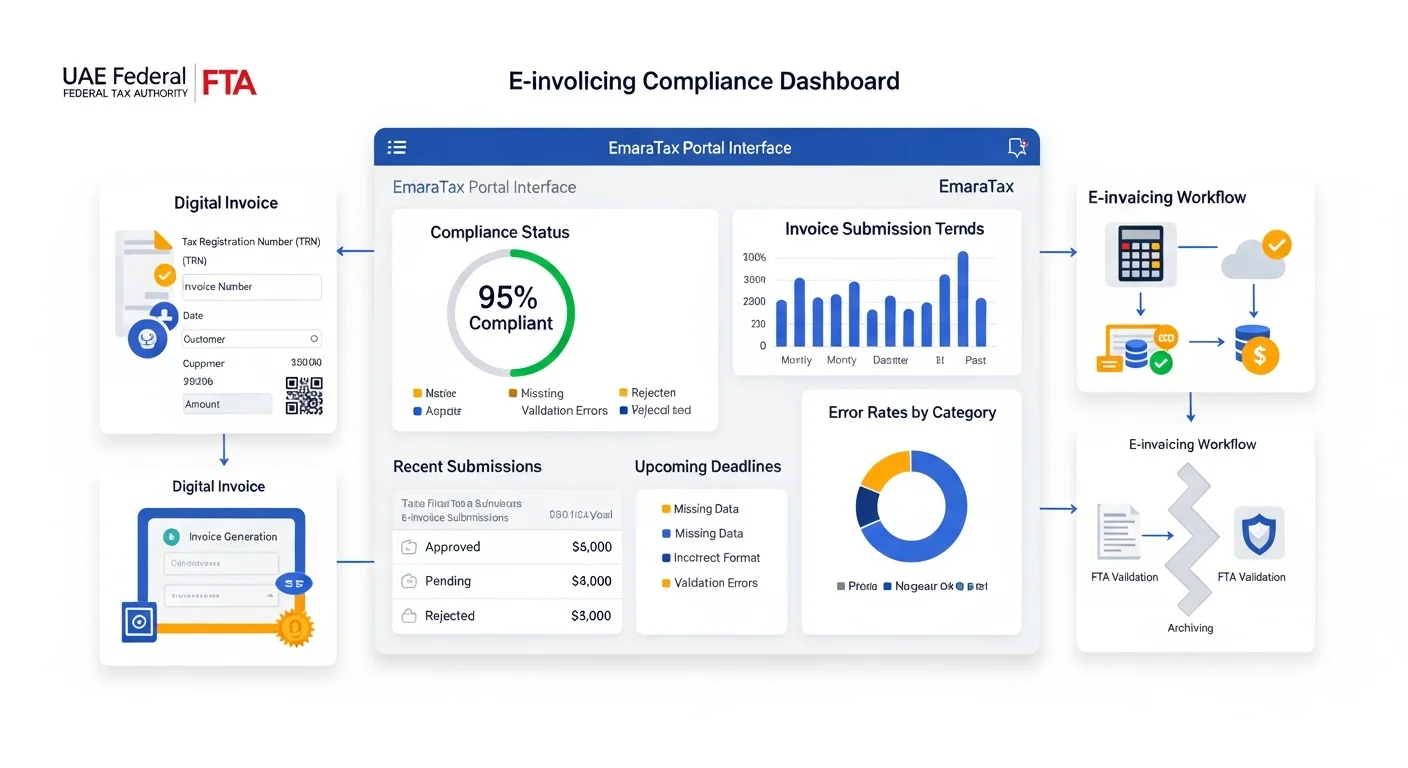
FTA E-Invoicing & Compliance Readiness Matrix
| Software | UAE VAT 201 | Corporate Tax Module | FTA E-Invoicing Roadmap | Bilingual Invoices |
|---|---|---|---|---|
| Site.pro | ✅ | ✅ | ✅ | ✅ |
| Zoho Books | ✅ | ✅ | ✅ | ✅ |
| QuickBooks Online | ✅ | Partner | Partner | Partial |
| Xero | ✅ | Partner | Partner | Partial |
| Tally Prime | ✅ | Add-on | Partial | ✅ |
| Wafeq | ✅ | ✅ | ✅ | ✅ |
| Sage Business Cloud | ✅ | Partial | Partner | Partial |
| Odoo | ✅ | Partner | Partner | ✅ |
| CrossVal | ✅ | ✅ | ✅ | Partial |
| FreshBooks | Basic | ❌ | ❌ | ❌ |
Pricing Comparison: UAE Accounting Software in 2026
| Software | Entry Plan (AED/mo) | Mid-Tier (AED/mo) | Pricing Model |
|---|---|---|---|
| Site.pro | Custom | Custom | Free Zone / SME tiers |
| Zoho Books | Free / ~55 | ~110–170 | Per organisation |
| QuickBooks Online | ~90 | ~150–250 | Per user / company |
| Xero | ~70 | ~140–250 | Per company, unlimited users |
| Tally Prime | One-time ~2,340 | One-time ~7,020 | Perpetual licence + TSS |
| Wafeq | 53 | 125–291 | Per company, unlimited users |
| Sage Business Cloud | ~220 | ~330+ | Per company, modular |
| Odoo | Free (Community) | ~30–70 / user | Per app, per user |
| CrossVal | Custom | Custom | Per company, AI tier |
| FreshBooks | ~60 | ~110–200 | Per user |
Prices are indicative as of Q2 2026 and rounded to AED. Always confirm with the vendor for your specific user count and modules.
Feature Matrix: What Each Tool Does Best
| Feature | Site.pro | Zoho Books | QuickBooks | Xero | Tally | Wafeq |
|---|---|---|---|---|---|---|
| UAE VAT 201 automation | ✅ | ✅ | ✅ | ✅ | ✅ | ✅ |
| Corporate Tax module | ✅ | ✅ | Partner | Partner | Add-on | ✅ |
| E-commerce sync (Shopify, Amazon) | ✅ | ✅ | ✅ | ✅ | ❌ | Partial |
| Multi-currency | ✅ | ✅ | ✅ | ✅ | ✅ | ✅ |
| Arabic invoicing | ✅ | ✅ | Partial | Partial | ✅ | ✅ |
| AI invoice recognition | ✅ | ✅ | ✅ | Partial | ❌ | Partial |
| Unlimited users | Plan-based | ❌ | ❌ | ✅ | Gold | ✅ |
| Free Zone fit | ✅ | ✅ | ✅ | ✅ | ✅ | ✅ |
Which UAE Business Should Use Which Tool
| Your Business Profile | Best Choice | Why |
|---|---|---|
| Free Zone company with a website / online store | Site.pro ↗ | Native site + e-commerce + VAT in one |
| 5–20 person SME wanting full FTA compliance | Zoho Books | FTA-accredited, EmaraTax filing |
| International business with foreign auditors | QuickBooks Online | Global standard reporting |
| Cloud-first team of 5+ users | Xero | Unlimited users on every plan |
| Trading / wholesale / import-export | Tally Prime | Best inventory management in UAE |
| Arabic-first or GCC-native company | Wafeq | Built for the region |
| Growing services / consulting firm | Sage Business Cloud | Modular and clean |
| Mid-size company wanting ERP | Odoo | One system for everything |
| SME wanting AI to file VAT | CrossVal | AI agent on EmaraTax |
| Freelancer or solo consultant | FreshBooks | Easy time tracking and billing |
Implementation Guide: How to Move to New Accounting Software in the UAE
Migrating accounting software is the part most UAE businesses underestimate. Here is a practical sequence that avoids the most common pitfalls.
Pick your fiscal-year start
The cleanest migration moment is the first day of a new VAT quarter or fiscal year — closing balances become opening balances.
Lock down your chart of accounts
Decide your COA structure first, in line with UAE Corporate Tax reporting categories, then map old accounts to new.
Verify your TRN, trade licence, and Free Zone details
All of these go into the software's tax setup and appear on every invoice.
Run a parallel month
Keep your old system running while you operate the new one for at least one month so you can reconcile.
Train the team
A two-hour session for issuing invoices, recording expenses, and pulling VAT reports is usually enough.
Engage an accountant for the first VAT filing
Even with the best software, the first VAT 201 done from a new system is worth professional review.
Common Mistakes UAE Businesses Make When Choosing Accounting Software
Mistake #1: Picking based on price alone
A AED 55/month plan that lacks Corporate Tax reporting will cost you 10x that in penalties.
Mistake #2: Ignoring the e-invoicing roadmap
With phased mandates beginning July 2026, software without a PINT-AE / Peppol roadmap is a future migration waiting to happen.
Mistake #3: Skipping the partner setup
A poorly configured chart of accounts produces unreliable reports for years.
Mistake #4: Forgetting about Free Zone-specific reporting
Free Zone entities have additional Corporate Tax positions that not every tool handles well. Site.pro is designed with this in mind.
Mistake #5: Underestimating user count
Per-user pricing on QuickBooks or FreshBooks can quietly become the most expensive line item in your operations.
Mistake #6: Not running a parallel month
Going live without validation almost always produces opening-balance errors that surface during the first audit.
Frequently Asked Questions
Which is the best accounting software for UAE businesses in 2026?
There is no single best — it depends on your business profile. For Free Zone and website-integrated businesses, Site.pro is the strongest fit. For UAE SMEs wanting FTA-accredited cloud accounting, Zoho Books is the most-cited option. Trading and inventory-heavy businesses still prefer Tally Prime.
Is VAT mandatory for all UAE businesses?
VAT registration is mandatory for businesses with annual taxable supplies above AED 375,000 and voluntary above AED 187,500, according to the Federal Tax Authority. Below that threshold, registration is optional but record-keeping rules still apply.
When does UAE e-invoicing become mandatory?
The UAE e-invoicing system is being rolled out in phases. The pilot begins July 2026, and Phase 1 mandatory adoption for businesses with revenue of AED 50 million or more begins 1 January 2027, per Ministry of Finance updates. All in-scope businesses are expected to be covered by July 2027.
Do I need software that is FTA-accredited?
FTA accreditation is recommended but not strictly mandatory — what is mandatory is that your software produces VAT-compliant invoices and accurate VAT 201 returns. FTA-accredited tools like Zoho Books simplify EmaraTax filing because the integration is direct.
Is Tally still good for UAE businesses in 2026?
Yes, but with a caveat. Tally Prime remains the strongest tool for inventory-heavy trading businesses. The caveats are that it is desktop-first, has no dedicated Corporate Tax module yet, and limited modern AI features. For traders it is still excellent; for cloud-first service businesses, less so.
Can I file VAT directly from accounting software?
Yes, with the right tool. Zoho Books, CrossVal, and Wafeq all offer direct or near-direct EmaraTax integration. Others (QuickBooks, Xero) generate VAT 201-ready reports that you submit on EmaraTax separately. Site.pro also prepares VAT return data natively.
How much should a UAE SME budget for accounting software?
For most SMEs, between AED 55 and AED 300 per month covers cloud accounting with VAT and Corporate Tax modules. Tally is a one-time investment of AED 2,340–7,020. Add 10–20% for partner setup if you need data migration.
What is the difference between Free Zone and mainland accounting requirements?
The bookkeeping requirements are similar, but Free Zone entities have additional Corporate Tax considerations (qualifying income, qualifying activities) and Economic Substance reporting where applicable. Site.pro handles Free Zone setups out of the box, reducing configuration time significantly.
Can I switch accounting software mid-year?
Yes, but the cleanest switch is at the start of a VAT quarter or fiscal year. Mid-year switches require careful reconciliation of opening balances, VAT control accounts, and Corporate Tax timing.
Where can I get help choosing and setting up?
Engage an FTA-registered tax agent or a UAE-based accounting firm for setup. Most vendors (Zoho, Site.pro, Tally, Odoo) have authorised UAE implementation partners who handle migration and first VAT filing.
Your 2026 UAE Accounting Software Roadmap
The UAE tax environment in 2026 is not the one that existed in 2018 or even 2023. Between VAT, Corporate Tax, and the FTA's structured e-invoicing rollout, accounting software has moved from a back-office tool to a compliance system. The right choice protects against penalties, surfaces real-time financial data, and connects your sales channels directly to your books.
| Your Goal | Best Choice | Expected Impact |
|---|---|---|
| Free Zone + website / e-commerce business | Site.pro ↗ | Single system for site, sales, VAT |
| Best Overall for UAE SMEs | Zoho Books | FTA-accredited cloud accounting |
| Best for International Operations | QuickBooks Online | Global standard reporting |
| Best for Trading & Inventory | Tally Prime | Industry-leading inventory |
| Best for Arabic-First Businesses | Wafeq | GCC-native bilingual platform |
| Best AI Tax Automation | CrossVal | AI files VAT and CT |
| Best for Freelancers | FreshBooks | Easiest time tracking and billing |
- Start this week: Shortlist 2–3 platforms based on your business profile.
- Run a demo of each: Test VAT 201 generation and invoice formatting.
- Engage a partner for setup: A correctly configured chart of accounts saves thousands of AED in audit corrections later.
- Go live at the start of a VAT quarter: Cleanest migration, simplest reconciliation.
Ready to get started with UAE-optimised accounting?
Site.pro is our top pick for Free Zone companies and website-integrated UAE businesses — one platform for your site, sales, and VAT compliance.
Get Started with Site.pro ↗